


A kitchen remodel goes smoothest when the big decisions happen on paper. Once the walls are open, the plumber and electrician rough in pipes, boxes and circuits to the plan, and the inspector checks that work before anyone closes the walls. A change after that point means opening finished work. Settle the decisions below first; the 2025 California codes, in force for permits filed since January 1, 2026, set the rules quoted here.
Start with how you cook
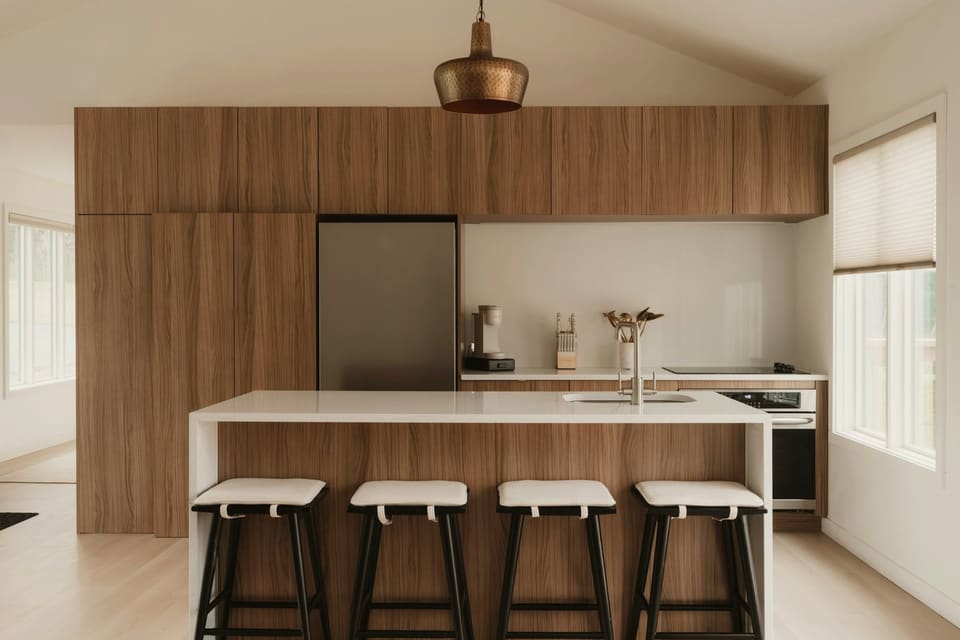
Draw the room around the way your household uses it. Where do groceries land? Who cooks while someone else cleans up? How many people sit at the island? Those answers place the sink, the range and the refrigerator, and those three set most of the plumbing, gas and electrical work.
A few code limits shape the layout:
- Clearance over the cooktop. The California Mechanical Code calls for at least 30 inches of vertical clearance above a cooking top to combustible material or metal cabinets, unless a listed microwave or other appliance installed over the range follows its own listing.
- Island outlets. An island or peninsula counter either gets a receptacle installed under the electrical code's rules, or the electrician leaves provisions for adding one later. Decide now whether you want power at the island.
- Counter outlets along the walls. Every wall counter space 12 inches or wider needs a receptacle, spaced so no point along the wall sits more than 24 inches from one, and mounted no more than 20 inches above the counter.
Pick appliances before the electrician roughs in
Appliances decide the electrical plan, so choose them, or at least their type and size, before rough-in. The 2025 California Electrical Code, as LA County cities summarize it in their kitchen remodel handouts, asks for:
- At least two 20-amp small-appliance circuits for the counter, dining and pantry receptacles, serving no other rooms.
- A separate 20-amp circuit for the disposal and the dishwasher.
- Ground-fault (GFCI) and arc-fault (AFCI) protection at the counter receptacles, with tamper-resistant devices throughout.
- New lighting and receptacles that don't overload the existing circuits or panel.
Switching to an electric or induction range can reach all the way back to the panel. One California city's 2025 handout notes that electric stoves and ovens need a 40- or 50-amp circuit, and that an older panel may need an upgrade or a subpanel to carry the new kitchen. Find out before you buy the range.
Order matters too. Ask for the lead time on cabinets, appliances, windows and special-order tile when you choose them. A kitchen can sit half-finished while one late item holds up the countertop template or the final inspection.
Plan the hood and the lighting
Under the 2025 California Energy Code, a replacement kitchen exhaust fan has to meet the airflow an earlier permit required, or 100 cubic feet per minute, whichever is greater, if that earlier permit called for a vented hood. Where the full requirement applies, the hood has to meet the code's airflow or capture-efficiency numbers and carry a sound rating. A hood that vents outside needs a duct route through the cabinets or the ceiling, so draw it in before the cabinet order goes out.
Lighting has its own rules. Kitchen light fixtures have to be high-efficacy, and recessed ceiling fixtures have to be rated for insulation contact, airtight and sealed to the ceiling. Fixtures have to meet the Energy Code's Joint Appendix JA8, so check the spec sheet before you buy.
What makes a kitchen remodel need a permit
The 2025 California Residential Code exempts painting, tiling, cabinets, countertops and similar finish work from permits on their own. Most kitchen remodels go past that. Pasadena's 2025 handout requires a permit when you remove and replace or move the cabinets and countertops, the sink, the dishwasher or an island, or replace or alter the electrical or the exhaust hood; a new countertop alone or refaced cabinets don't need one. The Permit Center on North Garfield Avenue handles kitchen permits; other cities keep their own lists.
A permit brings the rest of the house into the conversation:
- Water fixtures. California Civil Code 1101.4 makes replacing old high-flow fixtures throughout a single-family home built by 1994 a condition of final approval for any permitted alteration. The new kitchen faucet tops out at 1.8 gallons per minute at 60 psi.
- Smoke alarms. Permitted alterations require smoke alarms where a new home would have them.
Older homes need a dust plan
The federal government banned lead-based paint for homes in 1978. If your house is older than that, the EPA's Renovation, Repair and Painting rule covers paid work that disturbs paint, and demolishing painted surfaces is always covered. Our post on painting a pre-1978 home explains what lead-safe work looks like on site.
How we run a kitchen remodel
Kabaian Projects is a general contractor in Pasadena, and kitchens are one of our most requested jobs. Nareg Kabaian supervises the work on site every day, from demolition to the last day of work, and we answer calls and texts 24/7 while your kitchen is torn up. See the kitchen remodeling page for what a kitchen job with us covers, and our guide to remodeling contracts for what to read before you sign.
Sources
- Residential Kitchen Remodel (2025 codes) City of Pasadena Building & Safety.
- Kitchen remodel requirements, permits submitted on or after January 1, 2026 City of Sunnyvale.
- 2025 California Residential Code R105: permits via GoCodebook.
- 2025 California Residential Code R109: inspections via GoCodebook.
- 2025 California Residential Code R310: smoke alarms via GoCodebook.
- 2025 California Energy Code 150.2: alterations via GoCodebook.
- 2025 California Energy Code 150.0: mandatory features via GoCodebook.
- 2025 CALGreen 4.303: indoor water use via GoCodebook.
- Civil Code 1101.4: water-conserving fixtures California Legislative Information.
- Renovation, Repair and Painting Program: contractors U.S. EPA.
- Permit Center City of Pasadena.
Every house is different, and rules change. Talk to us about yours before you decide; nothing here replaces a walk-through of your home or advice from your city or a licensed professional.


